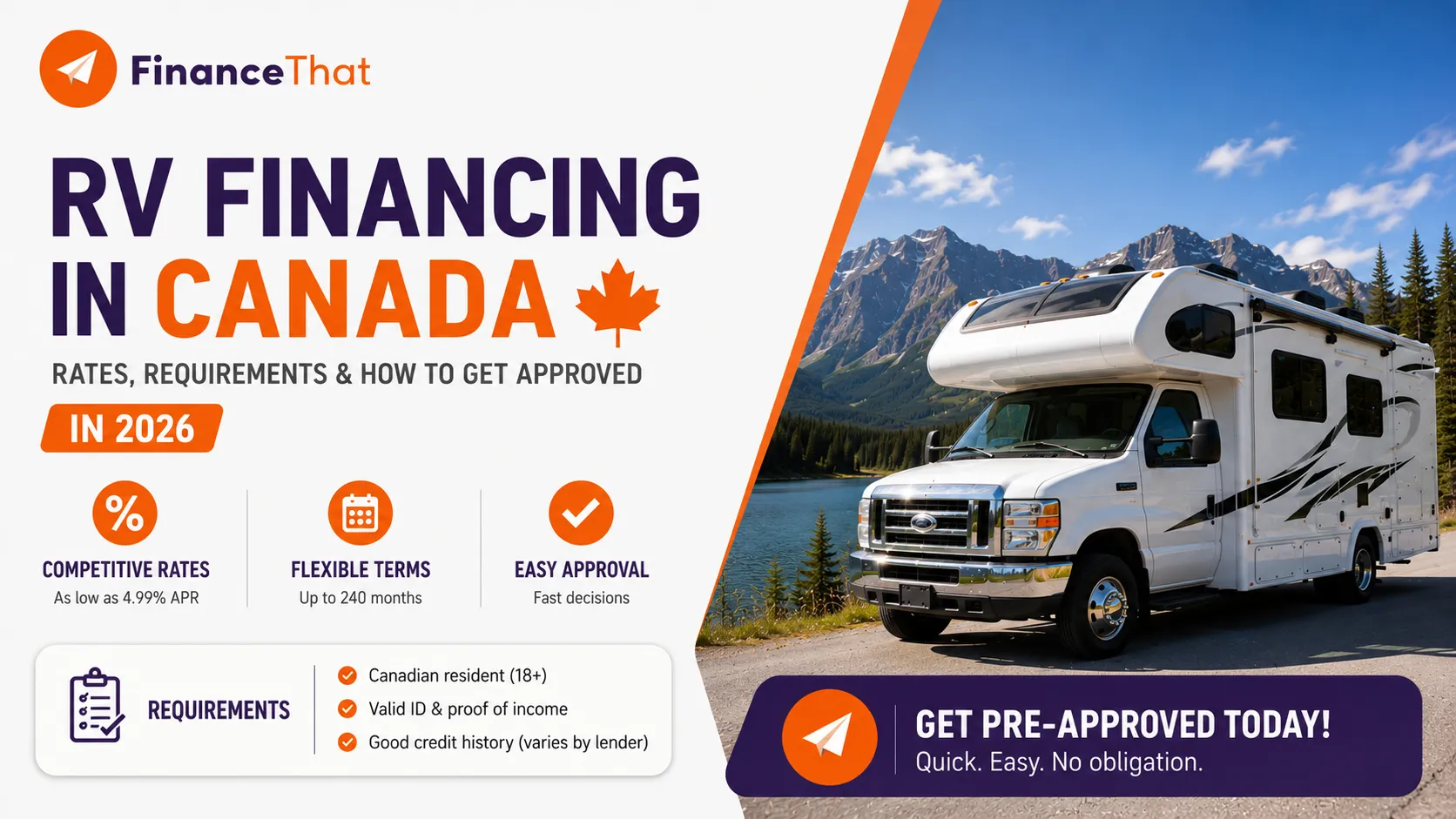






Learn how RV financing works in Canada in 2026. At Finance That you can compare RV loan rates, easy approval , bad credit options, private sale financing, down payments, and lender tips.
RV financing in Canada can be easier to qualify for than many buyers expect , but approval depends on more than just your credit score.
Canadian lenders look at your income, debt load, down payment, employment stability, and the RV itself before approving a loan. Whether you are buying a motorhome, travel trailer, camper van, or fifth wheel, understanding how RV financing works can help you secure a lower rate, avoid overpaying, and shop with confidence.
This guide explains:
- how RV loans work in Canada
- minimum credit score expectations
- RV loan rates and repayment terms
- bad credit RV financing options
- private sale RV financing rules
- how to improve approval odds before applying
How to Get Approved for an RV Loan in Canada in 2026?
In Short:
To get approved for an RV loan in Canada, lenders usually look at your credit score, monthly income, debt load, down payment, employment stability, the RV’s age, and whether you are buying from a dealer or private seller. Strong credit can help you qualify for lower rates and longer terms, while weaker credit may still be approved with a larger down payment, proof of stable income, or the right lender network.
The smartest path is simple:
- Check your credit first
- Set a realistic monthly payment
- Know your full ownership costs
- Get pre-approved before shopping
- Choose an RV that fits your income, not just your lifestyle
RV loans can stretch up to 20 years with some Canadian lenders. That helps lower the monthly payment, but it can also increase the total interest paid over time. The Financial Consumer Agency of Canada warns that longer vehicle loan terms lower payments but increase total interest cost.

Should You Apply for RV Financing Before or After Choosing an RV?
Apply before you fall in love with a unit.
That is the honest answer.
A lot of buyers start backwards. They find a fifth wheel, motorhome, camper van, or travel trailer first. Then they try to force the financing to match the dream.
That can lead to disappointment.
Pre-approval gives you a real budget before you shop. It shows what loan amount, payment range, term, and down payment may be realistic for your profile. It also helps you compare dealer units, private sale RVs, and marketplace listings without guessing.
This matters even more in 2026 because RV prices vary widely. Go RVing Canada lists broad price ranges across RV types, including Class A motorhomes from about $150,000 to $500,000, Class B motorhomes from about $100,000 to $300,000, travel trailers from about $35,000 to $150,000, and fifth wheels from about $50,000 to $150,000.
Your approval should guide the RV search. Not the other way around.
Should You Get Pre-Approved Before Buying an RV?
Most RV lenders look at the full file, not just one number.
Your credit score matters, but it is only part of the decision. Lenders also review whether the loan makes sense based on your income, existing debts, the unit being financed, and the risk of the deal.
Here are the main approval factors.
| Approval Factor | Why It Matters |
|---|---|
| Credit score | Helps lenders estimate repayment risk |
| Income | Shows whether you can afford the payment |
| Debt-to-income ratio | Shows how much of your income is already committed |
| Employment stability | Reduces lender concern about missed payments |
| Down payment | Lowers lender risk and can improve approval odds |
| RV age and value | Affects collateral quality and available term |
| Dealer vs private sale | Changes the paperwork, inspection, and lien-check process |
| Residence and ID | Confirms identity and Canadian borrowing eligibility |
Equifax Canada considers credit scores from 660 to 724 good, 725 to 759 very good, and 760 and above excellent.
That does not mean every borrower below 660 gets declined. It means the deal may need stronger income, a larger down payment, a co-signer, or an alternative lender.
What Credit Score Do You Need for RV Financing in Canada?
Most Canadian RV lenders prefer credit scores above 660, but some alternative lenders may approve borrowers with scores below 600 if income and down payment are strong.
There is no universal minimum credit score for every RV loan.
A borrower with a score above 700 will usually have access to better lender options, stronger approval odds, and more competitive rates. A borrower between 560 and 659 may still qualify, but the lender will usually look harder at income, down payment, debt load, and the RV being financed.
A borrower below 550 may still have options, but the file needs to be packaged carefully.
A simple way to think about it:
| Credit Profile | Likely Approval Path |
|---|---|
| 700+ | Best lender access, stronger rates, longer terms |
| 660 to 699 | Good approval potential with stable income |
| 560 to 659 | Possible approval through alternative lenders |
| Below 560 | Larger down payment or co-signer may be needed |
| No credit history | Possible, but income and stability matter more |
Finance That’s own RV financing page states there is no hard minimum credit score across its lender network, but rates and down payment requirements become more important for lower-score applicants.
RV Loan Rates in Canada for 2026
RV loan rates in Canada are not fixed across the market.
They change based on:
- Bank of Canada rate movement
- Lender type
- Credit profile
- Loan term
- RV age
- Down payment
- Dealer or private sale structure
- New vs used RV
As of April 29, 2026, the Bank of Canada held its target overnight rate at 2.25%, with the Bank Rate at 2.5% and deposit rate at 2.20%.
That matters because lenders use the broader rate environment when pricing loans. A lower-risk borrower with strong credit and stable income will usually receive a better offer than a borrower with recent missed payments, high debt usage, or a low down payment.
Rates may start in the high single digits for strong borrowers, while applicants with bruised credit may receive higher rates. Always compare the full loan cost, not only the monthly payment.
Buyers with bruised credit often benefit from popular lender marketplaces in Cananda such as Finance That that compare multiple RV financing options from one application.
RV Loan Term Comparison
| Loan Term | Lower Monthly Payment | Lower Total Interest |
|---|---|---|
| 5 Years | ❌ | ✅ |
| 10 Years | Moderate | Moderate |
| 15–20 Years | ✅ | ❌ |
How Much Down Payment Is Needed?
The down payment depends on credit, lender risk, and the RV itself.
Some prime and near-prime buyers may qualify with little or no money down. Subprime borrowers often need 10% to 20% down, and higher-risk files may need more.
A down payment helps in three ways:
- It lowers the amount financed
- It reduces lender risk
- It can make an approval easier on a used or older RV
A bigger down payment can also protect you from negative equity. That matters because RVs depreciate, especially during the first few years of ownership.
Do not only ask, “Can I get approved?”
Ask, “Will this loan still make sense if I sell or trade the RV in three years?”
That question protects the buyer.
Secured vs Unsecured RV Loans
Most RV financing in Canada is secured.
A secured loan uses the RV as collateral. If the borrower does not make payments, the lender may have the right to take the asset. The Financial Consumer Agency of Canada explains that secured personal loans use an asset as collateral and the lender may take the asset if payments are not made.
An unsecured loan does not use the RV as collateral. That can sound attractive, but it often comes with higher rates, shorter terms, and stricter approval requirements.
For larger RV purchases, secured financing usually makes more sense because it can support:
- Larger loan amounts
- Longer repayment terms
- More manageable monthly payments
- Better approval options
Unsecured loans may fit smaller RV-related purchases, upgrades, repairs, or accessories.
How Long Can You Finance an RV in Canada?
RV loans can run much longer than regular auto loans.
Some Canadian lenders offer terms up to 20 years for qualifying RVs. Scotiabank, for example, says its RV loan can provide up to $200,000 for an RV and allows borrowers to take up to 20 years to pay off the loan.
Longer terms can help with affordability, especially on higher-value motorhomes or fifth wheels.
But there is a trade-off.
A longer term lowers the monthly payment, but it increases total interest.
Example:
| Loan Example | Monthly Payment | Total Interest |
|---|---|---|
| $75,000 at 8% for 10 years | About $910 | About $34,200 |
| $75,000 at 8% for 20 years | About $627 | About $75,500 |
The 20-year loan saves about $283 per month, but costs about $41,300 more in interest over the full term.
That is why the best term is not always the longest term. It is the shortest term you can afford without creating payment stress.
Comparing lenders before shopping can help you avoid choosing an RV outside your approved budget.
What Documents Do You Need for RV Loan Approval?
Most RV lenders will ask for basic identity, income, and purchase details.
Prepare these before applying:
- Government-issued photo ID
- Proof of address
- Recent pay stubs
- T4 or Notice of Assessment if requested
- Bank statements if self-employed
- RV year, make, model, trim, VIN, and price
- Seller or dealership details
- Proof of insurance before funding
- Down payment confirmation, if required
Self-employed buyers should be ready with stronger income support. Lenders may ask for recent tax filings, business bank statements, or Notice of Assessment documents.
The more complete the file, the faster the approval.
Can You Get RV Financing With Bad Credit?
Yes, bad credit RV financing is possible in Canada.
But the deal needs to be realistic.
A lender may still approve an applicant with past credit issues if the file has strengths elsewhere. That might include stable income, a down payment, a lower-priced RV, or a co-signer.
Bad credit does not always mean no approval. It usually means the lender will ask harder questions.
Common approval boosters include:
- A larger down payment
- A cheaper RV
- Proof of steady income
- Lower current debt
- A co-signer
- A newer unit with stronger resale value
- No recent repossession or active bankruptcy
- Clear explanation for past credit issues
The biggest mistake is applying for too much RV too soon.
If your credit is rebuilding, a smaller travel trailer may be easier to approve than a luxury Class A motorhome.
Get approved, make payments on time, and use the loan as a rebuilding tool.
Can You Finance a Used RV in Canada?
Yes, many Canadian lenders offer financing for used RVs, including travel trailers, fifth wheels, camper vans, and motorhomes.
Approval depends on factors such as:
- the RV’s age and condition
- mileage for motorized units
- resale value
- purchase price
- lender guidelines
- borrower credit profile
Newer used RVs usually qualify more easily because lenders see them as stronger collateral. Older units may require a larger down payment, shorter repayment term, or additional inspection documentation.
Private sale used RV financing is also possible, although lenders may require a VIN check, PPSA lien search, inspection, and seller verification before funding the loan.
Can You Finance an RV With No Down Payment?
Some Canadian borrowers can qualify for RV financing with no down payment, especially if they have strong credit, stable income, and low existing debt.
However, zero-down RV financing is not available for every borrower or every RV type.
Lenders may still require a down payment if:
- the applicant has bruised credit
- the RV is older
- the loan amount is high
- the debt-to-income ratio is elevated
- the purchase is through a private seller
Even when no down payment is required, putting money down can reduce monthly payments, improve approval odds, and lower the risk of negative equity as the RV depreciates over time.
Borrowers with lower credit scores may need 10% to 20% down depending on the lender and the unit being financed.
Private Sale RV Financing Explained
Private sale RV financing is possible, but it needs more due diligence than a dealership purchase.
Finance That outlines a private sale process that includes finding the RV, applying with vehicle details, completing a PPSA lien search, arranging an inspection, releasing funds to the seller, and transferring ownership.
That process matters because private sales carry extra risk.
Before buying from a private seller, confirm:
- The VIN matches the ownership documents
- There are no liens on the RV
- The seller has legal ownership
- The RV passes inspection
- The price matches market value
- The lender is comfortable with the unit age and condition
The CRA also notes that GST/HST generally does not apply when buying a specified motor vehicle through a private sale from a person who is not a GST/HST registrant, but provincial motor vehicle tax may apply when registering the vehicle.
That detail is useful for buyers comparing dealership and private sale costs.
Dealer vs Private Sale RV Financing
| Factor | Dealer Purchase | Private Sale |
|---|---|---|
| Easier paperwork | ✅ | ❌ |
| Lien verification | Usually handled | Buyer responsibility |
| Inspection requirements | Lower | Higher |
| Financing flexibility | Moderate | Often stricter |
Province Matters More Than Buyers Think
RV financing is national, but the total purchase cost is provincial.
Taxes, registration rules, insurance costs, storage needs, and seasonal usage can vary by province.
Ontario buyers need to factor in 13% HST when the place of supply is Ontario. CRA examples confirm that taxable supplies delivered in Ontario are charged 13% HST.
Nova Scotia changed its HST rate to 14% on April 1, 2025, according to CRA.
Private sale tax treatment can also differ from dealership purchases. GST/HST may not apply to certain private sales, but provincial registration taxes may still apply.
That means your approved loan amount should consider the full on-road cost, not only the RV price.
Hidden Costs of RV Ownership
A comfortable loan payment can still become expensive if you ignore ownership costs.
Budget for:
- Insurance
- Fuel
- Storage
- Maintenance
- Winterization
- Campground fees
- Tires
- Roof seals
- Warranty coverage
- Emergency repairs
- Accessories
- Registration fees
This is where many first-time buyers misjudge affordability.
A $650 monthly loan payment might look manageable. But if insurance, storage, maintenance, and fuel add another $300 to $700 per month depending on usage, the real ownership cost changes fast.
Before applying, build a “real RV budget.”
Use this simple formula:
Monthly loan payment + insurance + storage + average maintenance + fuel + campground costs = real monthly ownership cost
That number matters more than the loan payment alone.
How to Improve Your RV Loan Approval Odds
Do these before submitting your application:
- Check your credit report
Look for incorrect late payments, collections, or balances. - Lower credit card utilization
High revolving debt can hurt approval, even with decent income. - Avoid new credit applications
Do not open new cards or personal loans right before applying. - Save a down payment
Even 10% can make a weaker file stronger. - Choose the right RV type
A newer travel trailer may be easier to finance than an older high-mileage motorhome. - Get pre-approved
Pre-approval helps you shop within a lender-backed budget. - Compare full loan cost
Do not choose a loan only because the payment is lower. - Be honest about income
Incomplete or inflated income claims slow approvals and may cause declines.
Dealer RV Financing vs Marketplace Financing
Dealer financing can be convenient. You choose the RV and complete financing in one place.
But it may not always show you the widest lender options.
A marketplace-style financing model can compare multiple lenders from one application. Finance That’s RV page states that one application reaches over 30 Canadian lenders, including banks, credit unions, and specialty recreational vehicle lenders.
That gives buyers more flexibility across credit types, RV types, and purchase sources.
Dealer financing may work well when:
- The dealer has strong lender relationships
- The RV is new or nearly new
- Your credit profile is clean
- You want a fast dealership process
Marketplace financing may work better when:
- You want to compare more lenders
- You have bruised credit
- You are buying privately
- You are not sure what you can afford
- You want dealer and private sale flexibility
When You Should Wait Before Financing an RV
Sometimes the best approval strategy is waiting.
Hold off if:
- Your income is unstable
- You have recent missed payments
- Your credit cards are maxed out
- You have no emergency fund
- You cannot cover insurance and storage
- You need the longest term just to make the payment work
- You are relying on future income to afford the loan
RV ownership should feel exciting, not financially tight.
A better move may be to rebuild for six to twelve months, lower debt, save a down payment, and apply with a stronger file.
Final Takeaway
Getting approved for an RV loan in Canada in 2026 is not only about having perfect credit.
It is about matching the right RV, lender, term, down payment, and monthly budget to your real financial profile.
Strong borrowers should focus on rate and total interest cost. Rebuilding borrowers should focus on approval strength, realistic RV selection, and payment history. Private sale buyers should focus on lien checks, inspection, and seller verification.
The best outcome is not just getting approved.
It is getting approved for an RV loan you can comfortably keep, enjoy, and pay down without stress.
Ready to compare RV loan options?
Apply through Finance That to get matched with Canadian RV financing options for dealer purchases, private sales, new RVs, used RVs, and all credit profiles.
Questions People Ask
What credit score is needed for RV financing in Canada?
Most Canadian RV lenders prefer credit scores above 660. Borrowers below that range may still qualify through alternative lenders if they have stable income, lower debt, or a larger down payment.
Can I get RV financing with bad credit?
Yes. Bad credit RV financing is possible in Canada, but the lender may require a larger down payment, proof of stable income, a lower loan amount, or a co-signer.
Is it better to finance a new or used RV?
New RVs may qualify for longer terms and better lender comfort because the collateral is newer. Used RVs may cost less upfront but can face stricter lender rules, especially if the unit is older.
How long can you finance an RV in Canada?
Some RV loans can run up to 20 years, depending on the lender, RV value, RV age, and borrower profile. Longer terms reduce monthly payments but increase total interest.
Can I finance an RV from a private seller?
Yes. Private sale RV financing is possible, but it usually requires more steps, including a VIN review, lien search, inspection, seller verification, and direct lender payment to the seller.
Do RV loans require a down payment?
Not always. Strong borrowers may qualify with little or no money down. Borrowers with weaker credit may need 10% to 20% or more depending on the lender and RV.
Should I use a bank, dealer, or financing marketplace?
A bank may work well for strong credit. A dealer may be convenient for dealership purchases. A financing marketplace can help compare more lenders, which is useful for private sales, bad credit, and buyers who want more flexible approval options.
Editorial Disclaimer
Rates, loan terms, and approval requirements vary by lender and borrower profile. Information is for educational purposes only and should not be considered financial advice.